

Live Well Post Diagnostics
We understand that hearing loss can affect your overall wellbeing.
Now that you have your hearing aids, we want to give you information to enable and empower you to navigate and take control of your hearing loss journey and improve your wellbeing.

5 Ways to Wellbeing
These are steps we can all take to protect and look after our mental well being. Developed by Public Health Wales to help society get the most out of life and to help people become aware of what contributes to positive wellbeing.
It is possible that due to your hearing loss you may be finding it difficult to carry out all 5 steps which means your overall wellbeing may be suffering.
You may feel disconnected from friends and family because you are struggling to hear on the phone or keeping up with the conversation when out in a cafe with friends. Assistive technology or communication techniques can support you to reconnect with your friends and family, small changes that can have a huge impact on the quality of your social life.

Connect
Connect with friends, family, local community and support services.

Be Active
This could be anything from exercising to just stepping outside your front door or into the garden.

Take notice
Take notice of what is going on in the world around you, this could be listening to the birds or watching the local news.
Keep Learning
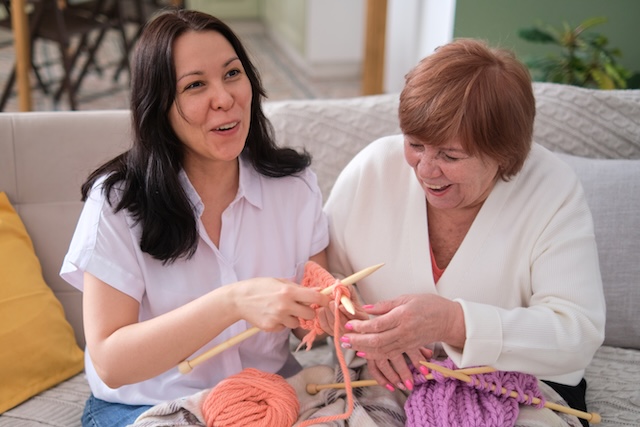
Keep learning about your hearing loss, start a new hobby or revisit an old one.

Give
Give back something to the community or help a friend or loved one. You could do this by volunteering.
Useful Communication tips

Make people aware that you are deaf or have a hearing loss and let them know your preferred communication style.
Where lipreading is possible:
- Make sure people face you when speaking
- Ensure you can see their face clearly
- Make sure. the person gets your attention before starting speaking
- Ask them to speak normally and not exaggerate their lip movement.
As a last resort, people may be happy for you to talk to a friend or relative who will relay a message. Always ask they are happy to do this beforehand.
These tips are particularly important when someone cannot use visual cues, such as on a telephone or when wearing a face mask:
Ask them to repeat or say things differently if you don’t understand what they have said.
- Reduce background noise as much as possible by moving to a quieter space
- Use assistive equipment like remote microphones and hearing aides
- Write things down, use pen and paper, text on device screens or whiteboards
- Ask them to speak clearly
Hearing Aid Programmes
You can have 4 programmes at one time
All around: every day use
Hear in noise: in noisy environments
Loop: for use with loop systems in theatres, banks etc
Music: for listening to music, musicians
Outdoor: for people who spend a lot of time outdoors, working outside or with outdoor hobbies.
Assistive Technology
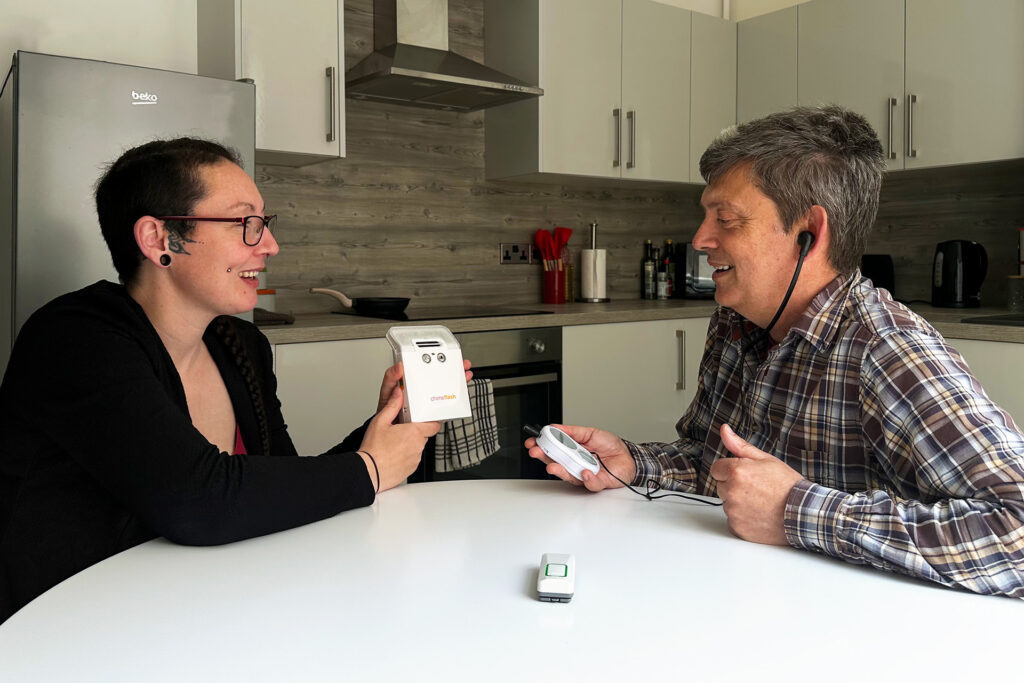
We can advise on a range of supportive technology. Click for more information.
Lipreading

Online lipreading practice – video clips as well as written exercises.
Skills and practice material in the sessions focus on learning to recognise the lip shape and movement of most sounds.
You can also find local courses at ATLA (Association of Teachers of Lipreading to Adults)
Text only: 07426 559602
info@atlalipreading.org.uk (excluding North Wales)
British Sign Language (BSL)
British Sign Language is a visual means of communicating using gestures, facial expression, and body language and is used mainly by people who are Deaf or have hearing loss.
BSL has its own grammatical structure and syntax, as a language it is not dependant nor is it strongly related to spoken English.
COS offers a range of BSL courses which can be delivered Face to Face on online via Microsoft Teams or Zoom. From Accredited courses to online sensory loss Continuing Professional Development (CPD) qualifying courses (available in English, Welsh & BSL)

Adult Sensory Services
Cardiff
If you live in Cardiff, we can, with your consent, refer you to Independent Living Services. A Contact Officer will be in touch to assess your case. You will either be referred to the Adult Assessment Team or Cardiff Care and Repair if you are over 50 years of age. They will discuss your needs and recommend and possibly supply certain equipment.
Vale of Glamorgan
If you live in the Vale of Glamorgan a referral can be made to the Hearing Impairment Social Care Office who will contact you to assess your individual needs. They will recommend and supply certain equipment.
Referrals can also be made to other sensory services if you live outside of theses areas.

Note: not all equipment is provided for free and this varies depending on where you live.
Access to Work
Access to Work is a publicly funded employment support programme that provides practical and financial support to people who have a disability or long-term physical or mental health condition, so they can start or stay in work.
How can it help me?
Examples of how they can help:
- Aids and equipment in your workplace
- Adapting equipment to make it easier for you to use
- An interpreter, Speech to Text Reporter, note taker or lip speaker
For more information visit www.gov.uk/access-to-work
Fire & Rescue – Home Visit & Advice
A Home Safety practitioner will telephone/e-mail/text you and will go through advice with you asking you a few questions about your home. If alarms are required, they will chat through a few options to get those to you.
They offer you the opportunity of a FREE Home Safety visit in your home. It will take about 30 minutes and they can provide and install free smoke alarms, heat detectors, and vibrating alert system where risk is identified.
South Wales Fire and Rescue Service
Free Phone: 0800 1691234
North Wales Fire & Rescue Service
Phone: 01745 535250
Care and Repair
If you are aged 60 and over a home owner, or Caseworkers can provide free advices and support to help you secure necessary home repairs & adaptations.
Useful contacts
Action for Deafness Cymru
www.actiondeafnesscymru.org.uk
cymru@actiondeafness.org.uk
Phone: 01443 485687
Cardiff & Vale Audiology Service
Phone: 02921 843179
Text only: 07805 670359
Audiology Helpline: CAV@wales.nhs.uk
Tinnitus UK
Phone: 0800 0180527
Text only: 07537 41684?
helpline@tinnitus.org.uk
Samaritans
Phone: 116 123 (free calls day or night)
jo@samaritans.org